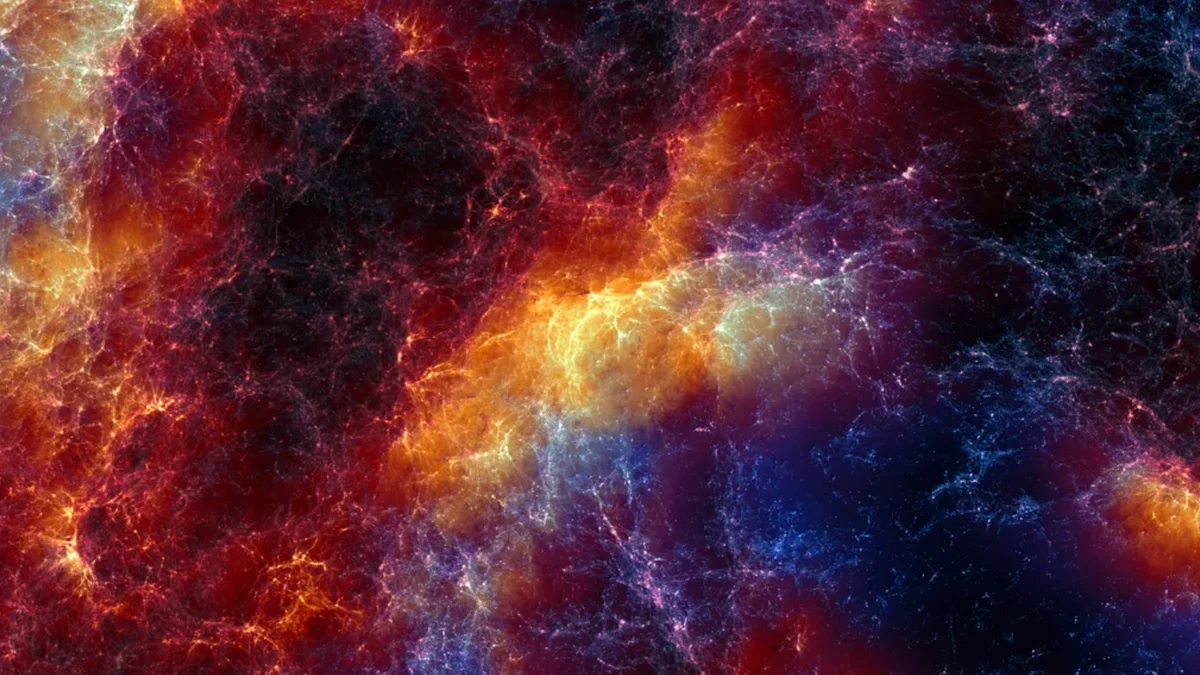
BLUF (Bottom Line Up Front): What if you could observe the end of the dark ages (in astronomical terms, it’s worth remembering), marked by the formation of the first stars and galaxies? This is what a new simulation of the first two billion years of the cosmos on supercomputers shows, developed by an international team of astrophysicists led by scientists from Harvard and MIT.
Called Lumina, the simulation models with unprecedented precision the end of the so-called “dark ages” and the beginning of the era of reionization, representing the processes that occurred on the colossal scale of 1.6 billion light years. By studying this transition, researchers can better understand how the universe evolved to what we see today.
The work integrates radiation physics, gas and dark matter, and the result is a virtual universe inhabited by more than 200 million galaxies. In addition to the visual spectacle, the tool allows scientists to follow the simultaneous growth of black holes and the transformation of interstellar hydrogen into heated plasma.
With Lumina, researchers discovered that predictions for gas between galaxies match observations from the James Webb Space Telescope, the most powerful observatory ever made. Interestingly, Webb has spotted galaxies more massive than those produced by the simulation.
“For me, one of the most exciting parts of this work is what happens when the simulations and observations disagree with each other: the simulations turn our understanding of physics into predictions, and comparing those predictions to the real universe helps us see where our models work and where something might have passed,” explained Oliver Zier, an astronomer at the Harvard Center for Astrophysics.
In the not-so-distant future, scientists will be able to count on another great ally to explore the cosmos. The Nancy Grace Roman telescope is moving toward its final orbit, which will allow it to study a wide area of the early universe—and, perhaps, finally reveal how many of these massive, bright galaxies must, in fact, exist.
The results were published in the scientific journal Monthly Notices of the Royal Astronomical Society.
Silicon Dispatch Strategic Takeaways
- Desk Alignment: Verified dispatch within the Science & Space pillar.
- Technical Verification: Hardware and software specifications corroborated against manufacturer roadmaps.
- Market Impact: Analysis tailored for North American enterprise decision-makers and high-performance tech enthusiasts.
Affiliate Disclosure: Articles published by Silicon Dispatch may include verified affiliate partner links. If you purchase through these links, we may earn an affiliate commission at no additional cost to you.