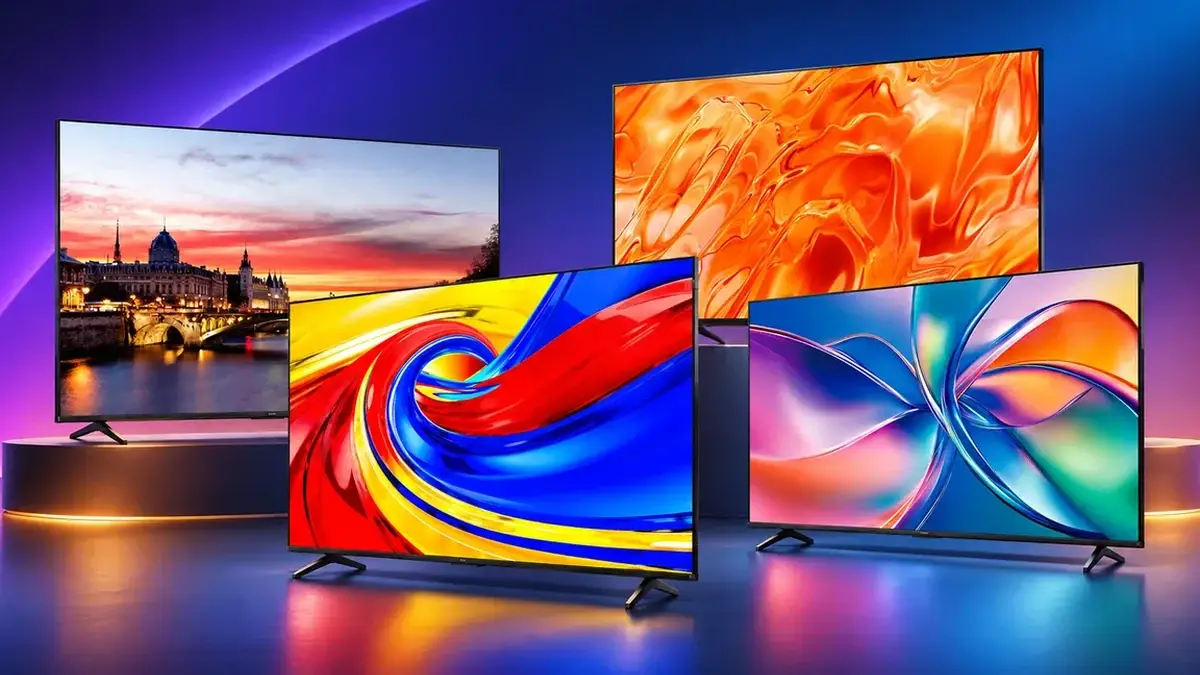
Comparing nine 65-inch 4K Smart TVs for 2026 reveals major architectural splits across self-lit OLED evo, Mini RGB LED, QD-Mini LED, and entry QLED panels. Models from LG, Samsung, TCL, and Hisense span 60 Hz to 165 Hz refresh rates within approximate $465 to $1,415 price tiers.
Disclosure: Silicon Dispatch is reader-supported. When you buy through links on our site, we may earn an affiliate commission at no extra cost to you. Learn more in our Editorial Policy.
Shopping for 65-inch 4K Smart TVs in 2026 is less about screen size and more about how each brand manages light, motion, and connected-home software. Two sets sitting side by side at the same 65-inch diagonal can deliver sharply different black levels, gaming bandwidth, and smart-home control.
Across nine current models from LG, Samsung, TCL, and Hisense, pricing alone no longer explains hardware capability. Several Mini LED sets remain locked to native 60 Hz panels, while an upper-entry QD-Mini LED model pushes native 144 Hz refresh rates at roughly half the cost of flagship OLED hardware.
How 65-Inch 4K Smart TVs Split Across Four Panel Architectures
Every model among these nine 65-inch 4K Smart TVs falls into one of four display tiers: entry QLED, standard Mini LED or QD-Mini LED, Mini RGB LED, and self-lit OLED. Understanding the backlight or pixel-emission design clarifies why approximate USD pricing stretches nearly threefold from bottom to top.
Entry QLED models such as the TCL P7L and Hisense Q6QV rely on quantum dot layers paired with conventional backlighting and 60 Hz panels. Moving up to Mini LED and QD-Mini LED tightens backlight control, though panel refresh rates diverge sharply between 60 Hz models like the LG QNED80 and 144 Hz options like the TCL C6K.
At the upper tiers, LG introduces its Mini RGB LED architecture on the MRGB85, while the LG OLED evo C6 and Samsung OLED S85F eliminate backlights entirely in favor of self-lit organic pixels. Display innovation continues moving rapidly across consumer electronics, as seen in our coverage of Samsung rollable OLED display targets for future mobile form factors.
Self-Lit OLED evo vs. Mini RGB and Neo QLED Backlights
The LG OLED evo C6 (2026) sits at the top of these nine 65-inch 4K Smart TVs, pairing self-lit OLED pixels with the Alpha 11 AI Gen3 processor. Because each pixel emits and dims its own light independently, OLED evo avoids backlight blooming around bright highlights on dark backgrounds.
For console and PC gaming, the LG OLED evo C6 pairs a native 120 Hz panel with variable refresh rate support up to 165 Hz alongside NVIDIA G-Sync and AMD FreeSync Premium. It also includes Dolby Vision and Dolby Atmos support, positioning it in the approximate $1,290 to $1,415 price bracket.
Samsung’s competing self-lit OLED S85F (2025) sits around $1,140 to $1,330 among flagship 65-inch 4K Smart TVs. It pairs a 120 Hz 4K panel with the NQ4 AI Gen2 processor, Dolby Atmos, and Samsung Gaming Hub, supporting HDR10+ while omitting Dolby Vision.
Just below OLED, two distinct Mini LED designs target buyers who want higher brightness without self-lit pricing. The LG MRGB85 (2026) uses Mini RGB backlighting with discrete RGB LEDs for finer color and luminance control, backed by the Alpha 8 AI Gen3 chip, Dolby Vision, Dolby Atmos, and 120 Hz native to 144 Hz VRR motion at roughly $845 to $930.
Samsung’s QN70H (2026) brings Neo QLED Mini LED hardware, the NQ4 AI chip, Vision AI tools, and SmartThings integration to mid-tier 65-inch 4K Smart TVs at roughly $860 to $1,000. Unlike LG’s MRGB85, however, the QN70H uses a native 60 Hz panel that hits 120 Hz only at reduced resolution.
Compare full panel specifications and US availability across our smart home display and TV hardware guide before finalizing your living-room upgrade.
Entry QLED, QD-Mini LED, and the 60 Hz Gaming Bottleneck
In the approximate $465 to $640 tier, hardware differences among 65-inch 4K Smart TVs become especially stark. The TCL C6K (2025) stands out on paper by pairing QD-Mini LED backlighting with a 144 Hz panel, Dolby Vision, HDR10+, and an integrated Onkyo 2.1-channel speaker system around $585 to $640.
By comparison, three similarly priced competitors stay limited to native 60 Hz refresh rates. The LG QNED80 (2026), priced around $570 to $620, pairs Mini LED lighting, Dynamic QNED Color Pro, the Alpha 7 AI Gen9 chip, and webOS 26, using Motion Booster at reduced resolution instead of native 4K 120 Hz.
Samsung’s M75H (2026), roughly $585 to $620, takes a similar path with Mini LED illumination, Tizen OS, Samsung Gaming Hub, and AI picture and sound upscaling. Its 60 Hz panel supports 120 Hz playback only at 2K resolution, omitting 4K 120 Hz support for current-generation consoles.
At the entry QLED tier, the TCL P7L (2026) combines a 4K HVA panel for improved native contrast, a slim chassis, Google TV, Dolby Vision, and HDR10+ at roughly $550 to $600 without Mini LED local dimming. Rounding out the group at roughly $465 to $520, the Hisense Q6QV pairs a 60 Hz quantum dot 4K panel with VIDAA OS, Dolby Atmos, and HDR support.
Specs and Approximate USD Tiers for Nine 65-Inch 4K Smart TVs
Comparing these nine 65-inch 4K Smart TVs side by side shows how refresh rate, HDR format support, and smart TV operating systems diverge even within tight pricing bands. Note that USD tiers below reflect approximate conversions from international retail ranges rather than confirmed US MSRP listings.
| Model (Year) | Panel & Backlight | Chipset & Smart OS | Refresh & Gaming | HDR & Audio | Approx. USD Tier |
|---|---|---|---|---|---|
| LG OLED evo C6 (2026) | Self-lit OLED evo | Alpha 11 AI Gen3 | 120 Hz native / 165 Hz VRR, G-Sync, FreeSync Premium | Dolby Vision, Dolby Atmos | $1,290-$1,415 |
| Samsung OLED S85F (2025) | Self-lit OLED | NQ4 AI Gen2, Tizen / Gaming Hub | 120 Hz native | HDR10+ (no Dolby Vision), Dolby Atmos | $1,140-$1,330 |
| LG MRGB85 (2026) | Mini RGB LED | Alpha 8 AI Gen3 | 120 Hz native / 144 Hz VRR | Dolby Vision, Dolby Atmos | $845-$930 |
| Samsung QN70H (2026) | Neo QLED Mini LED | NQ4 AI, Tizen / Vision AI / SmartThings | 60 Hz native / 120 Hz reduced res | HDR, SmartThings automation | $860-$1,000 |
| TCL C6K (2025) | QD-Mini LED | TCL processing | 144 Hz panel | Dolby Vision, HDR10+, Onkyo 2.1 audio | $585-$640 |
| Samsung M75H (2026) | Mini LED | Tizen OS, Samsung Gaming Hub | 60 Hz native / 120 Hz at 2K | AI picture and sound upscaling | $585-$620 |
| LG QNED80 (2026) | Mini LED, Dynamic QNED Color Pro | Alpha 7 AI Gen9, webOS 26 | 60 Hz native / Motion Booster reduced res | 4K Mini LED dimming | $570-$620 |
| TCL P7L (2026) | QLED with HVA panel | Google TV | 60 Hz class, gaming features | Dolby Vision, HDR10+ | $550-$600 |
| Hisense Q6QV | QLED Quantum Dot | VIDAA OS | 60 Hz panel, gaming features | HDR support, Dolby Atmos | $465-$520 |
As processing chips take on more upscaling and scene optimization duties across 65-inch 4K Smart TVs, silicon efficiency matters as much as raw panel glass. For another look at how modern silicon balances heavy workloads and power draw, read our Apple MacBook Pro 14 M4 Pro lab review.
Smart Home Ecosystems, US Room Sizing, and Power Context
Beyond panel contrast, these nine 65-inch 4K Smart TVs plug into distinct smart-home platforms. Samsung’s Tizen OS on the QN70H, M75H, and OLED S85F ties directly into SmartThings routines and Samsung Gaming Hub, while the LG QNED80 runs webOS 26, the TCL P7L runs Google TV, and the Hisense Q6QV runs VIDAA OS.
Before choosing among 65-inch 4K Smart TVs for a US living room, evaluate four practical checks alongside the smart platform:
- Room geometry: A 65-inch 16:9 display (~56.7 inches wide) suits 200 to 350 sq. ft. rooms at an 8.0 to 9.5 ft viewing distance.
- US power spec: North American units run on 120V, 60Hz circuits, with lower standby draw when always-listening hub features stay off.
- HDR compatibility: Match Dolby Vision apps to LG or TCL models, or choose Samsung sets for HDR10+ workflows.
- Built-in sound: The TCL C6K integrates Onkyo 2.1 audio, while slimmer chassis pair well with external Dolby Atmos soundbars.
Software personalization on modern displays mirrors broader AI assistant trends. For workspace customization tips, read our guide on how to set Gemini custom instructions across devices.
To narrow down these nine 65-inch 4K Smart TVs for your home, follow five steps:
- Lock your refresh floor: Pick the OLED evo C6, MRGB85, TCL C6K, or OLED S85F for native 4K 120 Hz gaming.
- Match panel to lighting: Choose self-lit OLED for dark rooms or Mini RGB and QD-Mini LED for sunlit rooms.
- Pick a smart-home OS: Align with Samsung Tizen and SmartThings, LG webOS 26, TCL Google TV, or Hisense VIDAA.
- Check HDR formats: Confirm Dolby Vision versus HDR10+ support for your streaming apps.
- Verify US SKU labels: Review retail EnergyGuide kWh/year labels and US warranty terms before mounting.
Ultimately, the strongest architectural value among these 65-inch 4K Smart TVs depends on whether native 144 Hz Mini LED brightness or self-lit OLED pixel contrast matters more in your room. Either way, separating true 120 Hz panels from 60 Hz lookalikes prevents paying upper-tier prices for entry-level motion hardware.
Read Next on Silicon Dispatch
- 10 One-Season Anime Series With Zero Filler Episodes: Explore compact animated series well suited for testing OLED contrast and HDR color accuracy on a new 4K screen.
- SpaceX Starship Catch Succeeds After 22 Hours in Orbit: Catch up on major aerospace engineering milestones with 4K launch coverage worth streaming on a large living-room display.
Frequently Asked Questions
What separates Mini RGB LED from standard Mini LED on 65-inch 4K Smart TVs?
Mini RGB LED on the LG MRGB85 uses RGB LED backlighting for tighter color and brightness control compared with conventional Mini LED sets. Across these 65-inch 4K Smart TVs, that design sits between entry 60 Hz Mini LED panels and self-lit OLED evo displays.
Which 65-inch 4K Smart TVs support true 4K 120 Hz or higher console and PC gaming?
Four models in this group support native 120 Hz or faster 4K gaming: the LG OLED evo C6 with 165 Hz VRR, LG MRGB85 with 144 Hz VRR, TCL C6K with a 144 Hz panel, and Samsung OLED S85F at 120 Hz.
Why does Dolby Vision versus HDR10+ matter across LG, Samsung, and TCL 4K TVs?
LG sets like the OLED evo C6 and MRGB85 support Dolby Vision alongside TCL’s P7L and C6K, which carry both Dolby Vision and HDR10+. Samsung’s OLED S85F relies on HDR10+ without Dolby Vision, shaping streaming compatibility across these 65-inch 4K Smart TVs.